









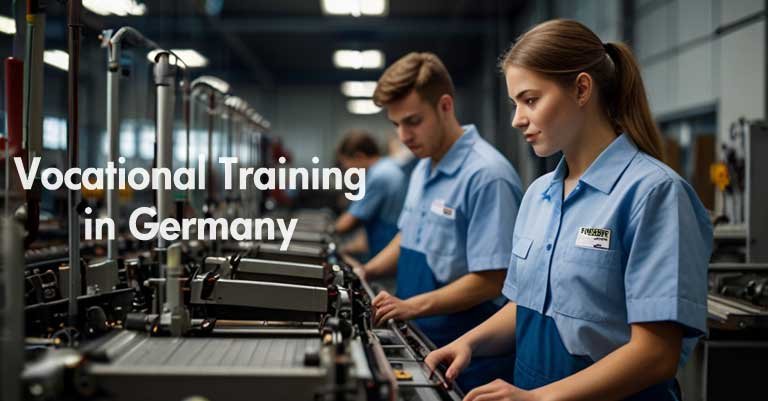
A vocational training course at vocational schools in Germany, known as Ausbildung, is an option not to be ignored if you’re looking for an excellent occupation in Germany. With more than 350 training options, this system provides a remarkable range of options. There are programs to meet your needs, whether you choose dual models that combine theory and practice in the workplace (Duales Ausbildung) or school-based training (Schulische Ausbildung).
By choosing a complete Ausbildung, you can obtain a specialized degree that is quite desirable in Germany. The German labor market places a high value on qualified professionals. As a result, this training serves as a genuine career launching pad, providing you with a bright future in Germany and great professional prospects.
Table of Contents
What is the German Vocational Training Program?
The vocational training system in Germany has been in place for a long time at several vocational schools in Germany. Germany boasts one of the best apprenticeship systems in the world. Ausbildung, another name for vocational training, aims to create trained workers by combining theory with practice.
In addition to awarding certificates, vocational schools in Germany aim to provide students with work experience related to their field of study. The apprenticeship program has been an important part of Germany’s market economy for a long time.
Vocational training in Germany gives graduates a competitive edge over unskilled labor by combining theory and practical application, providing a strong foundation for future employment options.
Benefits of Vocational Schools in Germany
Pursuing vocational training programs at any vocational school in Germany has various benefits, some of which are as follows:
1. Practical Skills:
Vocational schools in Germany emphasize the development of employable practical skills. This practical approach guarantees that graduates have the skills and are prepared for the workforce in their chosen sector.
2. Employability:
Graduates of vocational schools in Germany have great job opportunities. There are plenty of job opportunities in a variety of areas due to the nation’s robust economy and high demand for competent individuals.
3. Industry Recognition:
Employers in Germany place a high value on vocational qualifications. Graduates of vocational schools in Germany are in high demand since employers value the real-world experience they acquire through apprenticeships.
4. Route to Additional Education:
Vocational schools in Germany also offer a route to higher education. Building on their occupational credentials, graduates can pursue a university degree or further their education at a higher vocational school.
5. Funding Assistance:
In Germany, businesses are required to provide their apprentices with a training allowance. The cost of obtaining vocational training is lessened thanks to this financial assistance.
Popular Training Programs at Vocational Schools in Germany
Numerous vocational training programs in a variety of industries are available at vocational schools in Germany. Among the most well-liked programs are:
- Automotive Technology: Students who complete vocational training programs in automotive technology have the skills and knowledge necessary to work in Germany’s well-known automotive industry.
- Information Technology: Due to the quick development of technology, there is a great demand for information technology vocational training programs. Students who complete these programs will be prepared to work in fields like cybersecurity, network management, and software development.
- Healthcare: Students enrolled in vocational training programs are prepared for careers in medical assistance, nursing, and other healthcare-related fields. These courses blend classroom instruction with hands-on experience in medical environments.
- Engineering: Engineering is a discipline that Germany is renowned for, and students can specialize in mechanical, electrical, and civil engineering through engineering vocational training programs.
- Tourism and Hospitality: With its booming tourism sector, tourism and hospitality vocational training programs equip students with the skills they need to work in restaurants, hotels, travel agencies, and event planning.
Duration of Programs at Vocational Schools in Germany
An Ausbildung typically lasts two to three years in Germany. During this time, students attend a Berufsschule, a kind of vocational school, for a few days to obtain theory and practice instruction in the field of their choice. in addition to learning the skills and knowledge necessary to succeed in a particular trade.
Due to rapid changes in the job market, ausbuildung is becoming increasingly important in Germany. As the population ages and social and economic demands change, there is an immediate need for qualified workers. As a result, many young people in Germany who have low school-leaving qualifications are now accepted into vocational schools in Germany.
Educational Requirement
- Completion of 12th grade
- Age range: 18 to 25
- German language proficiency at the B1 level
How to Apply To Vocational Schools in Germany
To apply for Ausbildung in Germany, follow these steps;
- Find the Ausbildung that best fits your professional goals, skills, and talents by doing your research.
- Take German language classes to get the necessary proficiency.
- A B2 or B1 in German is normally the bare minimum required for Ausbildung programs in Germany for international students.
- Make contact with German companies and apply for the course.
- Participate in a virtual interview with a representative from one of the German Ausbildung course providers.
- After passing the interview, wait for the Ausbildung offer letter.
- Once the Ausbildung program visa has been granted, go to the Embassy for the interview and board a flight to Germany.
Related: Best Aviation School In Germany
Easy Vocational Schools in Germany
Since Germany’s education system is federalized and schools are run at the state (Länder) and local levels, there isn’t a single, comprehensive list of all vocational schools (Berufsfachschule) in the country. Therefore, this list includes a selection of schools and universities that also provide vocational programs.
1. HTW Hochschule für Technik und Wirtschaft:

The practical, hands-on Bachelor’s and Master’s vocational programs in engineering, computer science, business, and design are offered at HTW Berlin (Hochschule für Technik und Wirtschaft Berlin). There are no tuition costs because it is a public university, but there is a €290 semester contribution.
Bachelor’s degrees normally take three years to complete, whereas master’s programs usually take two years. The length of the programs varies depending on the particular course.
2. Bba – Akademie der Immobilienwirtschaft:

The BBA Real Estate Management program, which is in partnership with the bbw University of Applied Sciences, is one of the practical training programs, certificate courses, and seminars for the real estate industry that are offered by the BBA-Akademie der Immobilienwirtschaft (BBA Academy of Real Estate Management) in Berlin.
To prepare students for professions in project management, real estate financing, and management, the curriculum blends classroom instruction with hands-on training. The housing and real estate sectors are the focus of the BBA-Akademie der Immobilienwirtschaft. Both novices and seasoned industry professionals can benefit from the knowledge and practical skills these programs offer.
This dual Bachelor’s degree program typically requires seven semesters of study time. The cost of tuition for degree programs varies; for example, the dual BBA Real Estate Management degree costs €19,080 for the full program. Other courses could cost more or less. For example, the online Real Estate course costs €5,025.
3. Elinor-Ostrom-Schule:
The Elinor-Ostrom-Schule is a Berlin-based vocational school that offers both dual and full-time programs, such as Office Management and Warehouse Logistics Specialist. Recognized credentials, including B2-level certifications, are part of the programs. The cost and length of each program differ depending on whether it is full-time or dual system; full-time programs usually run two to three years.
4. Berlin Medical Academy:

The Master of Medical Education (Master of Arts in Medizinpädagogik), a teacher training degree centered on health education and instructing aspiring healthcare workers, is one of the vocational-like programs offered by the MSB Medical School. Although precise vocational training lengths are not specified, program durations vary by degree level, with bachelor’s degrees normally requiring three years and master’s degrees taking two years.
Private universities such as MSB Medical School charge tuition that varies from free for EU nationals to several thousand euros per semester for others, with specific prices given for particular programs.
5. Technical University of Munich:
With specializations ranging from structural engineering to electrical engineering, the Technical University of Munich (TUM) provides Vocational Education (B.Ed. and M.Ed.) programs for teaching at vocational schools. These programs normally span three to four years (6 to eight semesters for a Bachelor’s).
While many university programs in Germany are tuition-free, certain vocational education programs or international fees may apply. For the most accurate and current charges, interested intakes or graduates should visit the official TUM website.
6. RWTH Aachen University:
RWTH Aachen University provides vocational training for roles such as Elektroniker and Fachinformatiker, which typically lasts a few years and may include a monthly living allowance rather than tuition fees; however, specific costs should be confirmed directly with the university’s vocational training department.
While certain non-EU students may have to pay tuition for university degree programs, EU students typically do not have to pay for bachelor’s degrees.
7. Karlsruhe Institute of Technology:
Through a dual system that combines theoretical phases at a cooperative state university with practical training at KIT, Karlsruhe Institute of Technology (KIT) provides vocational training in over 30 technical, scientific, and commercial professions. The cost and duration of the program vary greatly depending on the applicant’s background and the particular profession. The vocational programs themselves don’t charge tuition, but students must be able to support themselves financially.
KIT uses a dual approach in which trainees take theoretical classes at a cooperative state university and have hands-on experience at the institute. Programs encompass a broad range of topics, such as scientific, technical, and commercial professions.
8. OSZ Lotis:
The primary occupation for which OSZ Lotis provides vocational training is tax clerk. Such programs usually last three years and consist of both classroom-based, full-time instruction and work-based, part-time training within a dual system. In the dual system, trainees earn a monthly wage from their job in addition to typically receiving free vocational instruction.
9. University of Rostock:
The Master of Education (M.Ed.) program in Vocational Education offered by the University of Rostock focuses on teaching at vocational schools and normally lasts two years. The program is free for German public universities. Students pay a semester fee that includes a student transportation pass and administrative services. The curriculum combines theoretical understanding with hands-on experience in Germany’s well-known dual vocational education system.
A postgraduate program called the M.Ed. in Vocational Education prepares students to teach at vocational schools. It explores the fundamentals of vocational pedagogy by fusing scholarly research with real-world, hands-on experience and firsthand knowledge of the German Ausbildung system.
10. University of Bayreuth:
As indicated by the bachelor’s and master’s degree options, the University of Bayreuth offers vocational training programs that run for several years, including a Bachelor of Vocational Education in Metal Technology and a Master of Education in Sports, Vocational Training. Tuition expenses for non-EU nationals can range from €1,500 to over €5,000 per semester; however, specific costs vary. For EU citizens, certain programs have reduced or no tuition.
The M.Ed. in Sports program lasts for two years. Other bachelor’s degrees typically take three years to complete, while vocational programs may have different time frames.
FAQ’s
Can I work part-time in Germany to complete my Ausbildung?
During your Ausbildung program, you are permitted to work part-time on Saturdays, Sundays, and other German holidays if you have authorization.
Can someone who doesn’t speak German apply for ausbildung?
German is the only language in which the Ausbildung courses are available. Therefore, the only way to apply to German Ausbildung programs is to study German.
Is it possible for me to stay in Germany after completing my education?
Yes, you can request an extension of your resident visa to stay longer in Germany in order to pursue employment if you receive a job offer from the training company or another business after completing your Ausbildung.
Conclusion
Vocational schools in Germany provide a useful and efficient route to a prosperous profession. Graduates are guaranteed to be well-prepared for the demands of the workforce thanks to the mix of theoretical knowledge and practical experience. Whether it’s in engineering, healthcare, computer technology, automotive technology, or hospitality and tourism, vocational training programs give people the credentials and abilities they need to succeed in their chosen fields.
Examine the several programs offered if you’re thinking about receiving vocational training at any vocational schools in Germany, then pick the one that best suits your interests and professional objectives. You may start a fulfilling career and support Germany’s booming economy with its robust vocational education and training system.